
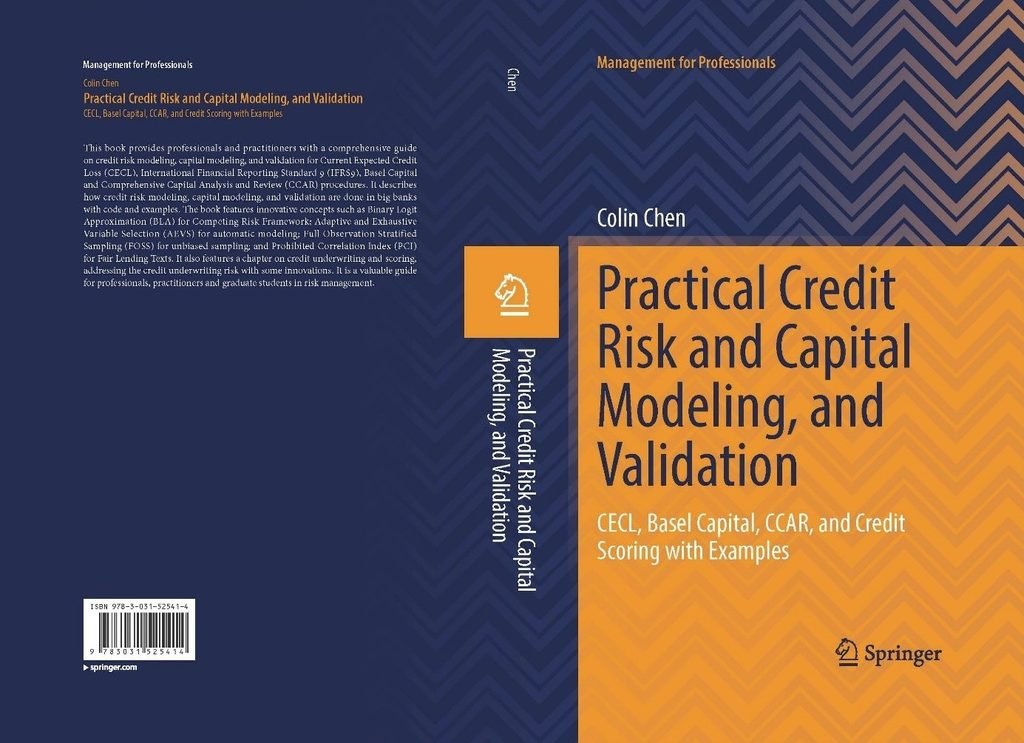
Practical Credit Risk and Capital Modeling, and Validation: CECL, Basel Capital, CCAR, and Credit Scoring with Examples (Management for Professionals)
Colin Chen is the Founder and Director of Data Science and Analytics Consultants (Bayside, NY, USA), which focuses on data science projects from financial and media industries. He has over 15 years of experience in financial risk management, having worked at JPMorgan Chase as an Executive Director of the Operational Risk Modeling Group and at Bank of America as a Director of Model Risk Management. He has also worked for Wells Fargo and Fannie Mae on credit and market risk models and for the SAS Institute as a Senior Software Developer.
This book provides professionals and practitioners with a comprehensive guide on credit risk modeling, capital modeling, and validation for Current Expected Credit Loss (CECL), International Financial Reporting Standard 9 (IFRS9), and Basel Capital and Comprehensive Capital Analysis and Review (CCAR) procedures. It describes how credit risk modeling, capital modeling, and validation are done in big banks with code and examples. The book features innovative concepts such as Binary Logit Approximation (BLA) for the Competing Risk Framework; Adaptive and Exhaustive Variable Selection (AEVS) for automatic modeling; Full Observation Stratified Sampling (FOSS) for unbiased sampling; and Prohibited Correlation Index (PCI) for Fair Lending Texts. It also features a chapter on credit underwriting and scoring, addressing the credit underwriting risk with some innovations. It is a valuable guide for professionals, practitioners, and graduate students in risk management.
Publisher : Springer
Publication date : April 23, 2024
Edition : 2024th
Language : English
Print length : 412 pages
ISBN-10 : 3031525418
ISBN-13 : 978-3031525414
Item Weight : 1.67 pounds
Dimensions : 6.14 x 0.94 x 9.21 inches
This book provides professionals and practitioners with a comprehensive guide on credit risk modeling, capital modeling, and validation for Current Expected Credit Loss (CECL), International Financial Reporting Standard 9 (IFRS9), Basel Capital, and Comprehensive Capital Analysis and Review (CCAR) procedures. It describes how credit risk modeling, capital modeling, and validation are done in big banks with code and examples. The book features innovative concepts such as Binary Logit Approximation (BLA) for the Competing Risk Framework; Adaptive and Exhaustive Variable Selection (AEVS) for automatic modeling; Full Observation Stratified Sampling (FOSS) for unbiased sampling; and Prohibited Correlation Index (PCI) for Fair Lending Texts. It also features a chapter on credit underwriting and scoring, addressing credit underwriting risk with some innovations. It is a valuable guide for professionals, practitioners, and graduate students in risk management.